
University of Isfahan Researcher Publishes New Book on Russia, Iran, Qatar and the European Gas Market
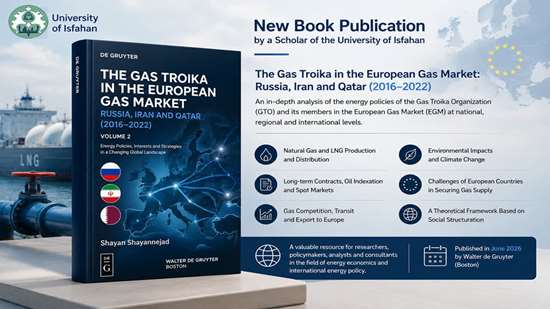
A faculty member of the University of Isfahan has published the second volume of the scholarly book The Gas Troika in the European Gas Market: Russia, Iran and Qatar (2016–2022), released by the Boston branch of the internationally renowned academic publisher Walter de Gruyter.
The newly published volume provides a comprehensive assessment of the energy policies of the Gas Troika Organization (GTO)—comprising Russia, Iran, and Qatar—and examines the role of both the organization and its member states in the European Gas Market (EGM) between 2016 and 2022. The book analyzes developments at national, regional, and international levels, offering insights into the strategic interests, energy policies, and institutional structures that shape the Gas Troika’s engagement with Europe.
The volume explores a wide range of issues, including natural gas and LNG production and distribution, long-term gas contracts and oil-indexation pricing mechanisms, spot markets, gas competition, transit and export routes, environmental impacts of natural gas, climate change considerations, and the challenges European countries face in securing reliable energy supplies.
The book addresses several key research questions, including how the members of the Gas Troika advanced their energy interests and policies in the European gas market during the period under study, how their shared interests influenced the organization’s framework and activities, and how the Gas Troika can be evaluated as a semi-cohesive regional and transregional energy organization.
Drawing upon the theoretical framework of Social Structuration, the publication integrates perspectives from energy geography, energy economics, energy policy, and environmental studies. As a result, it offers valuable insights for energy researchers, policymakers, analysts, consultants, and graduate students interested in global energy governance and international gas markets.
The publication of this volume follows the successful reception of the first volume by Walter de Gruyter. Following its positive evaluation by the publisher, the author was invited to develop a second volume covering the 2016–2022 period. Building upon previous experience with leading international publishers and collaborating with scholars from several countries, including Poland, Türkiye, and Iran, the project culminated in the publication of this new volume in June 2026.
The book represents another significant contribution by the University of Isfahan to international scholarship in the fields of energy policy, international relations, and global energy markets.


Comment